TEENAGE ADULATION AND CRITIC'S BARBS
ARE GOOD FOR DANNY ELFMAN'S SOUL
By Jeff Silberman
04/08/1983
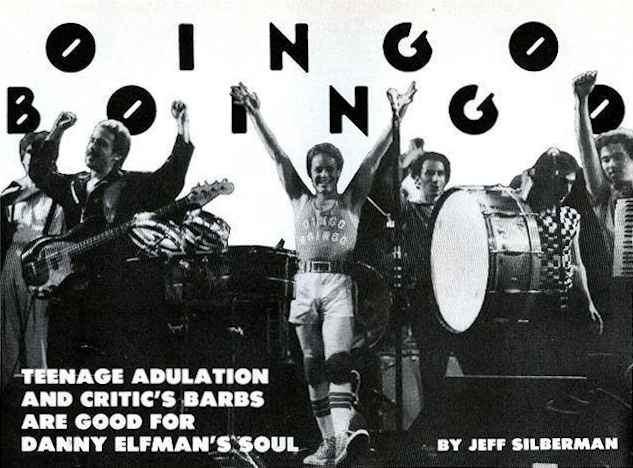
photo by Patricia Levy
There seems to be absolutely no middle ground when it comes to assessing Oingo Boingo. More than any other local band, this eight-piece ensemble, led by singer/songwriter Danny Elfman, has incited intense critical derision and, at the same time, equally strong adulation from the huge Southern California middle-class teenage audience.
Regardless of one's response to Oingo Boingo, be it positive or negative, the criticism rolls off Danny Elfman like water off a duck's back. He remains highly opinionated and adamant in his lyrical gist, no matter how conservative he seems to politically liberal critics. And while there is more musical variety on their new album, Good For Your Soul, it still is what Elfman describes as "Boingo."
On the other hand, Elfman takes nothing for granted when it comes to their popularity either. He's continuously flattered by the large, loyal audience, yet the increasing popularity of techno-pop, which he detests, might make the Boingo sound passe [sic] in comparison. About the only opinion that matters is Elfman's. He has always been the band's sternest critic; even with the imminent release of their third album, he pulls no punches when discussing his past work.
"The first album (1981's Only A Lad) was a big disappointment to us, only because we had tremendous problems with the producer, Pete Solley." he said. "The chemistry was all wrong between us. We shouldn't have recorded the way he wanted to; we never really got to hear the tunes until we were almost done. We had to remix everything because of a stupid-ass digital mastering process we used in Florida. We were one of the first bands to use this brand-new technique, but within the last couple of years, everyone I know who has tried it had to re-do their work. Even Rod Stewart did his whole album over again."
The second album, Nothing To Fear, was a step in the right direction. "It was more 'Boingo'," he stated. "There was less over-dubbing, and it was more versatile from song to song. You didn't hear the first tune and know what the rest of the material was going to sound like, which is my biggest criticism of contemporary pop/rock. We tried to avoid that, and for better or worse, we tried some other things, some that worked, some that didn't. There was more variety on Nothing To Fear, more percussion in the sound, and it was more fun to make. We tried to keep that concept alive for the new album."
Oingo Boingo continued to experiment slightly on their third album, including a new, quicker way to get a live sound on tape. "We were able to record 14 rhythm tracks in one week," Elfman said. "John (Hernandez, the drummer) was in the studio, but everyone else played live in the control booth. The one thing that always bothered us about working in the studio was being isolated and wearing headphones. It makes the [word omitted, presumably "sound"] feel less live; it became frustrating trying so hard to get the energy on tape that came so easy in concert. It became incredibly easy this way; everybody heard their individual parts within the context of the band."
Creatively, Elfman discounted any effort to radically revamp their sound to make it more accessible. "We don't set any preconceived concepts for any album," Elfman stressed. "We just try to find a balance between stuff that is recognizable Boingo [sic] and stuff that doesn't sound a lot like us. I don't know how to write commercial songs. It's common that songs I think are strange and atmospheric end up being the commercial songs on the album. Then there were three songs I wrote that I thought would be the commercial songs, and they ended up getting canned in the studio. I ended up hating them."
The OneS I ThinK Are StraNge
Are The CommerCiaL OneS."
One thing he has consciously avoided was the complex time changes and signatures that pervaded in Oingo Boingo's early work. "I don't like being known as that quirky thing out there. I got really sick of being compared to Frank Zappa's music because of the strange beats. I was originally into that because it happened naturally. All I was really concerned about was hitting them on an emotional level. I don't want to overwhelm people with how I can work complex rhythms into my music. Personally I'm not impressed with that at all. To me, it's the song and what the musician's put into it, the power and the guts."
If there is a discernible change in the Boingo sound on Good For Your Soul, it is in the emphasis on the guitar firepower of Steve Bartek and Elfman. "I always liked a lot of guitars," he said. "If anything, there's been a change in our attack because we wanted to use less synthesizers. The guitars simply have more space. Our early stuff had the guitar parts doubled by synthesizers and/or horns, so there was a lot of competition. We're getting away from that; we want to keep it real basic and let each instrument distinguish itself."
But the biggest development is in the vocals, where Elfman's often hiccupy vocal style has been toned down on several numbers. "I need a challenge too; I want to expand," he declared. "On 'Good For Your Soul,' 'Nothing Bad Ever Happens To Me,' and 'Pictures Of You,' there is definitely more control in the vocals. I'm even singing in lower registers. I could do a whole album of over-the-top screaming, but I've already established that. On this album, I wanted to do the other stuff as well. I found myself writing songs with different kinds of vocal parts; it's something I've wanted to do for a while."
One thing that hasn't changed one iota is Elfman's basic lyrical message. "I bring up certain elements on every album. From the EP on, I have tried to drive home a certain point about resisting peer pressure and groups. I want to get that message across, but keep a sense of irony and humor within it. Kids don't like to be preached at; they have to hear it from their teachers and their parents. The main point I try to get across is no matter who tells you 'I am right,' question them. If anyone—friends or political groups—try to make you think a certain way, resist it and question it. People should think for themselves."
"I'm anti-group," he continued. "I don't align myself to any cause, be they charities or anti-nukes. I may agree with their point, or I may not, but I don't like to have that pounded in. The biggest danger facing this country is fanatics, religious groups that try to legislate morality. It happens on a much smaller scale everywhere too, the (Jane) Fondas and (Tom) Haydens. I don't want any group to tell my girlfriend that she can't have an abortion, and I don't want someone to force me to pay for some social program that I think is destructive just to fulfill their idea of social progress. That's why I put '1984' on the new album; there are little Big Brothers everywhere."
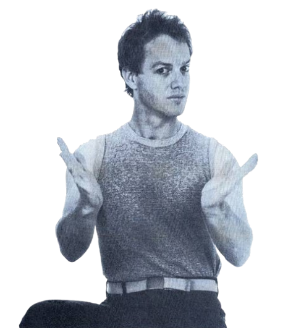
photo by Elaine Galka
Elfman's political view and performing style forces both the audience and critics to choose sides, and the polarity of opinion on Oingo Boingo suits him just fine. "I much prefer that to just being wishy-washy," he declared. "I don't want to please everybody. People find my attitude irritating; they don't know what to make of it. A lot of people expect a performer to exude a certain warmth that I won't do, like fake cordiality. I put my energy into the music; I don't say anything onstage that I don't feel at that certain moment. I have a real strong reactionagainst [sic] theatrics, the 'Is everybody happy?' speeches that align you to the audience. When I do that, I feel phony. That bothers a lot of people."
Most of all, Elfman's music and style bother critics, who have spared no bile in their put-downs of Oingo Boingo. When told of other bands who whine about how bad reviews can hurt or destroy a career, Elfman retorted, "Oh, bullshit! We thrive on that! We get a kick out of rotten reviews. Some, like Don Waller's review of our Halloween Show (in the Los Angeles Times), confirm to us that we're on the right track. There's a certain kind of rock critic who has got his head so far up his ass, and it's so obvious, that they are saying exactly what we expect them to say, including insulting our audience. They're trying to keep a finger on the pulse of the kids, but when they see 6000 of them respond to our music which they think is totally irrelevant or wrong, they respond by slamming the crowd. Their conception of 'kids' is really old punks and art fucks, which is such a small tangent of the real L.A. street scene. The real kids are in high schools all over, and the critics can't accept their tastes. Waller even had the audacity to say that they don't know how to dance! That epitomizes the concept of the idiot critic."
"As soon as we started playing as just Oingo Boingo, we knew very quickly we'd run into tremendous walls of restraint from critics. We weren't playing the relevant, so-called 'street music', which originally derived from the Dylan era and was revived for Springsteen. Critics grew up with that in the 1960s, and never forgot. I always knew I'd be in trouble with those guys because, to me, the 1960s were a washout; it was bullshit, full of hypocrites. I'd keep reading about Dylan, Dylan, Dylan, how he was the spokesperson for the generation. I tried to like him. I even pretended to like him, but I just hated him. It just didn't connect. Then Springsteen came along, and it was the same thing."
Oingo Boingo's first two albums each sold in the neighborhood of 125-150,000 records, over half in the Southern California area. Even with that solid base to try to break Good For Your Soul nationwide, Elfman is anything but secure about his chances for mass success. "I don't try to pretend I know what tastes are across the country," he admitted. "I really see it as completely unpredictable. I never know what to expect, so I don't think we have anything locked up. Our tastes have strayed quite a bit from where KROQ's tastes have gone, and we have consciously tried not to move into the techno-pop area. What happens next is anybody's guess. We have a tremendous, loyal following in Los Angeles which consistently amazes me. I hope that the kids who have been good to us will listen and accept us. Maybe they will and maybe they won't. We never anticipate anything."
While Elfman expresses uncertainty over the fate of the new album, he also stressed that a big, nationwide breakthrough is not Oingo Boingo's ultimate challenge. "If mass success was the key, I would have written a song that I know would have been accepted," he declared. "It's not that hard to do; it's just a matter of writing songs I don't like. I don't want to be saddled with a song that may break barriers, but that I don't like doing. And if I do that, then I lost the game. There are two sides to music; there's the pure love of writing and performing, and then there's the business side, radio and such, and that's a game. Winning that game means you don't have to struggle anymore. But if I have to do songs that I don't like just to get accepted, then I lost. Just do what you like and hope something hits."
Source 1 - Source 2 - Source 3 - Source 4
.jpg)
.jpg)
.jpg)
.jpg)
Return