LUNCHING WITH BONZAI
by Mr. Bonzai
--/07/1987
 My first view of Oingo Boingo was at a Halloween concert in Los Angeles where the band and the fans were dressed to the outer limits. I had spent hours fitting a pair of panty hose on my head and stuffing them with lumps of cloth and cotton. I applied pancake makeup over my enlarged cranium and pasted whisps of crepe hair here and there. With cosmetic putty I built up my nose to Charles Bukowski proportions. I tied a sweater over one shoulder to make me a hunchback, and then put on a natty, three-piece, pin-striped suit and a pair of decent wingtips. I was "The Elephant Man," but the film had just come out and nobody recognized me. I overheard a totally punked-out vamp in leathers comment, "Yecch—that's really gross." I must admit, there was a certain satisfaction in disturbing an Oingo Boingo fan.
Their music, of course, was anthemic, encouraging the wild crowd to party with the spirits of the dead. No slouches, Oingo Boingo works hard for their music, employing a horn section that squirts, bleats, honks and sweats. The rhythms chug around the world in less than 80 bars. Danny Elfman (vocals, rhythm guitar), Steve Bartek (guitar), John Avila (bass, vocals), Johnny (Vatos) Hernandez (drums, percussion), Sam Phipps (tenor sax), Leon Schneiderman (baritone sax) and Dale Turner (trumpet) are musical vampires, sucking the blood from any style or period, and bringing it new life. A highlight of the concert was the appearance of dueling six-foot Godzillas appearing from the wings and shooting it out with cowboy sixshooters.
Mrs. Bonzai and I loaded up the Bonzaimobile with beaujolais and the hardware of photo-journalism. We drove into the Santa Monica mountains and stepped into Danny Elfman's woodsy hideaway. He was out hiking when we arrived so we sat chatting with his daughter Mali, and her au pair, Maria. The two dogs and two cats had discovered a small snake with a crimson band around its neck. Harmless enough, I guessed, but to play it safe, I swept it into a flowerpot and set it free outside the grounds. Mali was fascinated with the little critter, as were the animals.
We asked the babysitter if we could explore a stream that led into a boulder grotto. We discovered a bona fide little waterfall pouring over the giant stones and paused in the serenity, looking forward to meeting Danny Elfman, the red-haired firebrand of Oingo Boingo.
Bonzai: What's the most frightening movie of all time?
Elfman: That's hard to say—frightening is all relative to the age at which you see the movie. For me, the most frightening movie I've ever seen is, in retrospect, not frightening at all. It was The Beast with Five Fingers, because it had the most profound effect of any scary movie I've seen since then. It triggered a lifelong series of recurring dreams that I still have to this very day, of being pursued by body parts, especially the hand. I always loved that film—must have seen it a dozen times.
Bonzai: Who starred in that?
Elfman: Peter Lorre. Now, when I see it on TV, of course it's quite humorous. And by today's standards, the special effects are quite inadequate. But that's a wonderful thing about the mind of a seven-or eight-year-old. Their imagination can do much more to that kind of imagery than any true-to-life special effects.
Bonzai: What gifts did you get from your parents? What did they contribute to your life and career?
Elfman: They gave me a lot of support. Certainly, they weren't pleased with my choice of careers. . . .
Bonzai: Are they now?
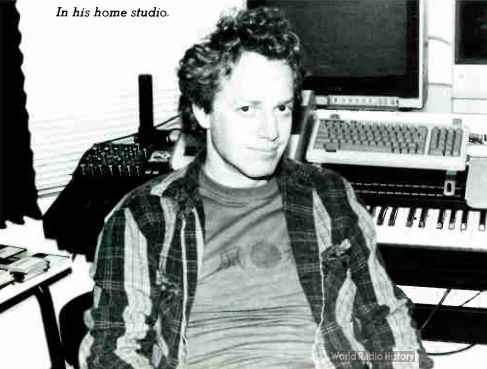
PHOTO: Mr. Bonzai for Pacific Bridge
Elfman: Oh, yeah, but I think any parent would have been a little bit upset. They're both schoolteachers—and they saw their child take a nonacademic road in life, one that seemed so totally without any possible means of security, which it really doesn't have. Starting a band, working in a theater group for years—that kind of stuff. They always said, “I know you love doing this, but how are you going to earn a living?"
Bonzai: Were you born in California?
Elfman: Yes, I was born and raised in LA. I think I got a good sense of logic from my father. He always looked at things very analytically. I have always done that throughout my life. When things ever get real bad, or tough, I'm able to step back and analyze the situation calmly. That's been a major factor in my enduring against all odds in many long-term ventures.
My mom was more artistically inclined. So, that might have something to do with certain artistic inclinations I have. She wrote stories for children when I was growing up. She was a good puppeteer and was a great storyteller. She ended up quitting teaching and became a novelist, and that took a lot of guts. She's written romance and mystery and actually done OK for herself. I suppose both artistic and analytical influences are there.
Bonzai: Elfman is your real name?
Elfman: Yes, but we've never been able to trace the roots, because my ancestry is Polish-Russian Jew. Elfman, to the best of our knowledge is a German name, "elf" meaning eleven. Anything could happen to Jews in that part of the world over a hundred-year period. It's very difficult to trace—could have been German for some generations. My great-grandparents came from the old country.
Bonzai: Can you remember a first profound musical experience?
Elfman: Well, I remember becoming aware of music in the prime of my sci-fi horror infatuation—the ages of ten to 13. I went to the movies practically every weekend. I realized at one point that all of my favorite science fiction movies had the same film composer—that seemed to be important. The Day the Earth Stood Still, Time Machine, Jason & the Argonauts, Seventh Voyage of Sinbad were all scored by Bernard Hermann. At the time I didn't realize who he was, but someone told me that the same person did all the music. He also did many of the Hitchcock scores. He was a very big influence, and later I became infatuated with the Hitchcock films.
It was a dream of mine to be able to score films, but I had no musical talents or inclinations. I imagined that if I worked in film it would be as an editor, or a cinematographer. Funny how it all wrapped around two decades later, and there I was a film composer.
Bonzai: Who gave you instruction in music?
Elfman: I'm self-taught completely.
Bonzai: Besides Bernard Hermann, did you have any other musical heroes?
Elfman: Nino Rota was my big musical hero—that's probably why I got the job to score Pee-wee 's Big Adventure. I was infatuated with Nino Rota, and they had toyed with the idea of a score that would touch on Nino Rota's influence. When I said that he was my main musical hero, along with Bernard Hermann, I think that really clicked. What got me the job certainly wasn't my musical experience.
Bonzai: What is your most important musical tool?
Elfman: That depends. When I'm doing orchestra scoring, I'm not using much technically except for the SBX80, my most important musical tool, because I lock all my timings directly from SMPTE time code through the SBX-80. There are my bars and I map out all my hit points that way. With the use of that, I've never had to use the Knudsen click book or any of the old-fashioned methods of making the music fall where I want it to. For orchestra scoring, the SBX-80 has been my single most valuable tool. In fact, I couldn't have done most of what I've done without it.
For the synth scoring I've done, the Macintosh has been the most important overall tool—the Performer, Mark of the Unicorn software.
Bonzai: How about just sitting down and coming up with a song?
Elfman: That's kind of split. Half of it is just playing guitar, and half of it would be the Performer. Even though it has flaws, it still seems to be the best on the market. There are a few things that would make it so much better, but I'm sure they know they have the most versatile program on the market today. Still, I couldn't have done a lot of what I've done without that program.
Bonzai: Originally the group was called "Mystic Knights of the Oingo Boingo?"
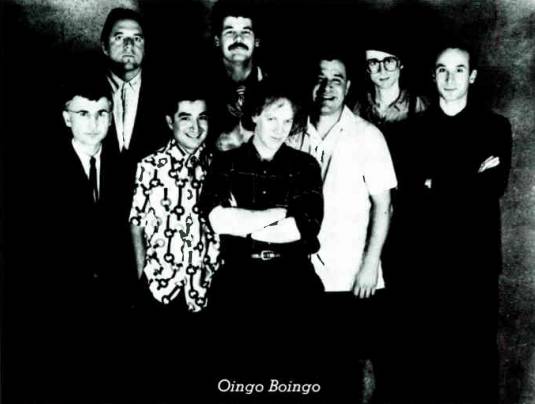 Elfman: No, not actually. Mystic Knights was an entirely different ensemble. It was not a band, it was a theatrical troupe that played music, although the music was very diverse and non-contemporary. It ran its course, and the ensemble ended in late '78. The only link to the band is that we kept the name Oingo Boingo, after we buried the Mystic Knights. There were several of us in the Mystic Knights who felt we had taken it as far as we liked. We were starting to get bored and talked for about a year about how much fun it would be to have a band. "Ah, we don't have the guts to do that, things are going so well for us—we'd have to start from scratch." Finally, at a certain point, we just said, "What the hell? If we're going to do it, let's do it right now." Half the group left, and half started Oingo Boingo.
Bonzai: Does Oingo Boingo have some special meaning?
Elfman: None whatsoever.
Bonzai: Do you believe in magic?
Elfman: I don't know too much about magic. I've never dallied in the Black Arts. The closest I've come to it was my experiences in West Africa. No matter how skeptical one starts out, you start believing in the ju-ju, because it's such a very strong part of the culture. It's difficult to explain, but it's probably similar to what you would find in aboriginal culture. I brought back some wonderful little objects. At first, I tried to collect some, but people wouldn't let me have them at any price. They looked at me and thought I was a white devil. And the white skin represented the devil for a lot of people. Finally, I found this one lovely woman who saw me looking. There's a ju-ju section in every marketplace, with barrels of multi-colored powders and lots of bird beaks, claws, and more rarely, monkey paws and digits of monkey fingers. Each one has a different function. I always wanted a monkey paw but it wasn't until I met this woman—I pointed, she held it up and said, "This is yours, right?" No problem.
Bonzai: Kinda spooky having it around?
Elfman: No, I don't think it's brought me any bad luck.
Bonzai: That reminds me of your brother's film, Forbidden Zone. You played the devil.
Elfman: Yes, my brother wrote it, directed, produced and financed it. He's working on another one now.
Bonzai: Was that your first film score?
Elfman: Yeah—I would call it an illegitimate film score. I wasn't scoring with my traditional techniques, but it was the first time I put music to film.
Bonzai: Who's the most amazing artist you've worked with?
Elfman: I've hardly worked with anybody. I've never been in another band; I've never worked with any outside musicians; I've never collaborated on a song, so it's difficult to answer that question. The only collaborative types of endeavors I've had were film projects. Band work is all very personal and very private. In film work, I'm turning to something that someone else started and I supplement and finish. When it comes to songwriting, the guys in the band are the only ones I've ever worked with. Steve Bartek, our guitarist, is my partner and does all my orchestrations for film. We work both sides of the fence together. He's worked with me on every film score I've done, and also has been there since the very beginning of Oingo Boingo. He's been a part of every song, arranging and structuring the tunes.
Bonzai: Do you have any advice about the music business? Any interesting business tricks?
Elfman: Not really. It's so unpredictable and difficult to figure it out. If one thinks logically, it can be very frustrating to figure out why and how record companies work the way they work, and come to the decisions they come to. You'd almost think there was more ju-ju involved, than just pure and simple gut feeling, or logic. I have learned a lot in the seven years that I've been with MCA and A & M. In the early years I was involved in representing the group's business, so I sat in on the business meetings, and was also on the band side. That was educational, but aside from that there is an enormous amount of luck involved. Any company can be horrible or great, depending on who you are and what your relative experience is with them. There is no single company that's always good, or always bad. A company can seem very open and free, and creative and good with one artist and be very restrictive and manipulative with another.
We've been lucky to have good relationships with our record companies, but then again, we are the type of artists who keep control over everything we do. Maybe it's because we don't allow ourselves to be manipulated. Nobody's ever tried to. Or maybe they come to bands like us because we are a self-sufficient entity, and they don't need to or want to manipulate all the time. No one at any record company has ever asked us or told us to do anything we didn't want to do.
Bonzai: Can you imagine yourself as a working musician in another period in history?
Elfman: The '30s, the actual roots of the Mystic Knights, both in terms of early Duke Ellington, Cotton Clubstyle big band jazz and French neoclassic European type of music. That to me was the single most exciting period, musically, of the century—between what was happening with Gershwin and the incredible revolution in jazz here, and what Stravinsky and the European composers were doing there. There was a double musical revolution happening simultaneously, and sometimes they would overlap, as they did with Gershwin and Darius Milhaud. He did a wonderful piece called "The Cow on the Roof," which reminds one of "Rhapsody in Blue," and they were written at the same time. Both of them used to sit in at the Cotton Club in the balcony and had similar influences. A wonderful mingling of cultures, and that created a clash—nothing has ever come close to it. To me, the so-called musical revolution in the '60s in rock and roll was a drop in the bucket compared with what came out of the '30s. Fifty years later, the music is still relevant. For me, the music of the '60s, with a few exceptions, had lost its relevance by the '70s. Although, someone may say in the future that the Moody Blues were as relevant as Stravinsky.
Of course, there was also a great jazz revolution in the '50s and '60s in America, and other individual contributions, but the '30s were unique.
Bonzai: As a performer, is there any star of the silver screen that you identify with? Peter Lorre?
PHOTO: Mr. Bonzai for Pacific Bridge
Elfman: No, I don't think I ever felt that frustrated. He did represent the extremely frustrated, twisted personality. If I was to identify with an actor from that period it would be Vincent Price's character, someone with a twisted imagination but definitely more in control. He'd be the one doing the torturing, as opposed to the one being tortured. Since I've always been somewhat of a control freak in my own life, I would identify more with that character.
Bonzai: If we could arrange a luncheon with anyone in the world, living or dead, who would you invite?
Elfman: I'd love to have Ellington, Stravinsky, Gershwin, Django Reinhardt (with a French translator), John Coltrane, Bertolt Brecht, Kurt Weill (he was another big influence on me), Nino Rota, Bernard Hermann, Jean Cocteau. . . .
Bonzai: Who is the Salvador Dali of music?
Elfman: Certainly no one today that I am aware of. I would think of one of the post-classical, or neo-classical composers somewhere in the middle of the century, someone with wild abstractions, but realistically portrayed with the orchestra in the same way that Dali realistically portrayed with paints. Perhaps Stravinsky. His wild abstractions were presented in extremely illegitimate well-formed style—extremely stylized, very difficult to duplicate exactly, realistically. No shortcuts were taken. That's what I think of with Salvador Dali; all the detail is there. You can magnify any portion of his paintings and it will look very real and distinct, as you can magnify any eight bars of one of Stravinsky's pieces and it will have this enormous amount of detail and subtlety and layers.
Bonzai: What is your most normal human characteristic?
Elfman: The family life is my anchor, the normal side—my wife, my children.
Bonzai: What's the biggest mistake of your life?
Elfman: I don't know; I don't really totally regret anything that I've done. It's easy to say, "Well, gee, if I'd have started Oingo Boingo the rock band in '72 instead of '79, I'd be that many years ahead." But on the other hand, the experience I gained from the theatrical ensemble is in many ways invaluable. I treasure that stuff, so they're not lost years.
I hate the way some of my early records sound. If I could go back in time, I wish I could go back with what I now know about recording, and make those first records sound the way I wanted them to sound. That was a very frustrating period artistically. The records always ended up sounding just the opposite of the way we intended them to sound. The sound was so one-dimensional on the early recordings. They still play them on the radio and it drives me up the wall. I wanted a big, open, dimensional sound and I got a very flat sound with no perspective. We didn't capture the live energy that we wanted. If I could go back, I would record much more live and try to get the spirit and feeling that we have on stage. It took three albums to start to learn how to get that type of sound.
Bonzai: What's the most important question that you can ask yourself?
Elfman: The same question I ask myself all the time. Could I be doing better? Could I be working harder? All of us in the band are our own worse [sic] critics. We drive ourselves pretty hard. I drive myself especially hard. When is enough enough? When is a song finished? The discipline in my mind, especially in pop music, is to work quickly. We have been forcing ourselves to work very quickly in the studio, because it seems that the quicker we work, the happier we are with the outcome. We spent three times longer on our first three albums, and everyone is telling me that the production qualities are so much better on the last two. In fact, we put a lot less production into the last two.
Bonzai: What about music video?
Elfman: We used to be much more into videos. When we started out, they were much cheaper; it was more fun and wild and crazy. Each year we would do one, but over the last few years I've started to pull out of it. It's more of a pressure, the budgets are four times higher to pull off the same thing. For the first time, with our latest single, we decided not to do a video.
Bonzai: Do you have any long-range visual goals for Oingo Boingo?
Elfman: Not really. Occasionally, when we have the facility, we'll use a little animation, or this or that, but I can't ever see relying on it too heavily. Then it becomes a crutch. The challenge of a band is that the music should be able to support itself.
Bonzai: Didn't the new album debut at 30 in Billboard?
Elfman: No, no, we're not that high yet. We're in the 70s, and we've never even broken the top 100 before. We need to have a few big hits off the album before we get to the 30s. We have one major hurdle to overcome—radio. There is resistance from programmers. Once we accomplish that, we'll make some headway. We're chipping away with a chisel on a concrete wall. There's light poking through here and there but there's a way to go before the bricks start to fall.
Bonzai: Doesn't your film work add fuel to the machine?
Elfman: No, not really. They seem to have their own personal way of dealing with image and it's very hard to shake a negative image. They're just getting over seeing us as this very wild, enormously uncommercial entity—a West Coast oddity.
Bonzai: "Weird Science" did well, didn't it?
Elfman: It did pretty well, but being our way, we did not follow it up with another "Weird Science." If we had followed with two or three imitations—that's the way that radio works. We are hopeful that we will break through this year, but it's still an uphill battle.
Bonzai: Will you be touring heavily?
Elfman: A lot more than in previous years.
Bonzai: You seem to have arrived at a pastoral place in your life here, up in the mountains.
Elfman: Yes, and we're out and far away from neighbors to avoid problems with noise. I can play in my studio as much as I want, all night long and nobody seems to hear anything. I went to great lengths with double glazing on the windows and a lot of insulation in the walls, and until I get my Rancho de Elfman, I'm quite content.
Bonzai: Let's take a tour of your studio. . . .
Elfman: The system here was really designed as much, if not more, by Steve Bartek than myself, in terms of the MIDI flow, which is quite complicated. Although I do most of my master keyboard playing from the KX-88, I can switch to the Octopad, to the DX7, or send data in from the Prophet 2002s, or a drum machine from this optional space.
Then from here I'll split from my masters, either the KX-88 or the computer, which would be patched through when I'm using stuff in conjunction from the computer. So I just switch from record to any MIDI channel that I'm working on, and that will instantly change the instrument without pushing any buttons.
And here is my selection of slaves, once I have the master selected. I like this system much better than the computerized switching boxes, because I don't have to memorize presets. I just hit on whatever combination I want, on or off. The Roland MPU-105s will select which instruments will play and the MPU-104s are the master selection boxes. Essentially, the difficulty was in finding a system in which anything can control anything else. I came up with the initial system. Actually, when I was in the studio, I had a vision of the MIDI flow chart and I wrote it all down. However, it had a lot of holes in it, and Steve took it and elaborated on it quite a bit, and made it much more elegant, added some nice refinements and twists, and simplified it.
As you can see, I could have the keypad here or if I'm not using the computer, I could have some music paper sitting up here on the SBX-80, which I use constantly. I have two Prophet 2002s, which I use a lot. I have several hundred disks which I am still sorting out.
When I'm doing a synth score, I'll bring in the third 2002. I have the Prophet VS rack, which is just in to replace the Prophet VS keyboard. I have the DX7 II Plus, the new one with disk drive, which is going out on the road as a backup for the band. And five more DX7 modules down here tucked away. I got the Roland digital piano, MKS-20—which I use constantly. That's my most used instrument, because when I'm writing I just use the piano. And I love the MKS-30 Planet- S. I'm looking for a second and they don't make them anymore, so I'm looking for a used one. Still one of my favorite Roland keyboards was a very early model, one of the first five-voiced digital keyboards. This is the rack-mounted version, which I like quite a bit. And my console is a modified Soundcraft 1600. All the channels have been regrounded and all the IC chips replaced. All the wiring in my Octopus box and everything else was designed by John Dressel, the Sunset Sound Factory tech who helped me put all this together, and wired up the Sony 24-track.
And here's my Fostex half-inch 2-track, which I got for playback and editing, so I could do all my sequencing and editing here. We don't actually mix here, so in a way I didn't need a 2-track. I only do the direct recording here and then finish up the tapes with live recording and mixing in the studio. On the other hand, I couldn't play the tapes, so I got that recently. Now I can play any of the masters that have accumulated and do all my editing here at home. Everything we do now is on half-inch. Occasionally, I have used it—when we did Pee-wee's Playhouse, we mixed right here. And I recently did music for a wonderful animator, Sally Cruikshank, and mixed it all here.
Bonzai: And the punching bag is for getting rid of studio tension?
Elfman: Yeah, but I work out more on the rings. Jump up there and hang upside down. It does wonders for the back, especially when I'm scoring. That's when I spend 12 to 14 hours a day bent over the piano.
Mr. Bonzai, a 15-year veteran of the music industry, is former manager of a major Southern Cal recording studio, and author of Studio Life: The Other Side of the Tracks (Mix Publications).
.jpg)
Return