ODD MEN OUT
by Michael Amicone
16/04/1990
Oingo Boingo
For over a decade, Oingo Boingo has existed on the fringes of rock,
amassing a fine body of work and a devoted cult following.
Boingo Mastermind Danny Elfman talks about the band and his soundtrack work.

.jpg)
(Bottom row, L-R) Carl Graves, Danny Elfman, John Avila, Johnny "Vatos" Hernandez, (middle row) Leon Schneideman, Steve Bartek, Dale Turner, (top) Sam Phipps.
Two wooden figurines guard the isolated lodgings of Oingo Boingo leader Danny Elfman. Like creatures out of a Clive Barker horror film, the two wooden warriors, one sporting nails on its body, stand at attention in a dark corner of the upstairs living room. For any one familiar with Elfman's body of work, either as the Merlin-like leader of Oingo Boingo, or as the soundtrack composer of the films Batman, Beetlejuice and Nightbreed, it makes sense that these Nigerian figures—which take two men to fashion, one to carve and one to exorcise their spirits—would be part of his household. They're the perfect house guests for an eccentric pop shaman who, over the course of a decade, has focused on what he calls the three m's—the morbid, the morose and the macabre.
On a recent sultry afternoon, I visited Danny Elfman's home nestled in the hills north of Santa Monica. Following a steep walk down a winding path of steps only slightly less precipitous than the uphill climb I had just traversed in my car, I was ushered into a sparsely furnished upstairs room filled with assorted collectables plundered from the cultures of distant lands. There, with fellow Oingo Boingo members Steve Bartek and John Avila listening in, I talked with Elfman about his illustrious soundtrack work and about Oingo Boingo and their decade-plus existence on the fringes of popular music.
Since their first recordings in the early Eighties, this eight-piece rock band has earned themselves a devoted following on the West Coast for their kinetic brand of thinking man's dance rock but precious little support from the larger record-buying public. Perhaps it's Danny Elfman's unwillingness to address the usual pop song fodder in his songs—most of the time he's grappling with more complex issues, such as isolation, death, suicide or his own angst, preferring to shine a light on the shadows of human existence—or maybe it's simply another case of cream not always rising to the top.
"It's nonconstructive to be frustrated about the commercial end of the business—something that I've never had much faith in, and I still don't now," says Elfman. "And radio is getting more and more restrictive every year, and I only see it getting worse. In the Sixties, FM played anything, all the time. There were always surprises. And FM is now what Am was back then. It's even more corporate, more restrictive and based even more on demographics. I don't know what the answer is. The answer, for us, is not to bank on it."
With Elfman coming off a career roll in soundtrack work—from Scrooged to Batman to the soon-to-be-released Dick Tracy—during which he has become one of the hottest composers in film, and with the release of Oingo Boingo's fine new album, Dark At The End Of The Tunnel, MCA, who bankrolls Elfman's fanciful flights into the inner and outer pop limits, is obviously hoping that this could be the commercial turning point for the band.
 Does Elfman feel this record has a better chance at commercial success than its predecessors? "I never have any idea, and I never think about it when I'm making the record," retorts Elfman. "That's for the record company to think about. Their job is to take an album and market it; our job is to make it."
Oingo Boingo has always buckled with the prevailing pop winds. During the Seventies, when everyone was immersed in singer-songwriter introspection and strangling on the numbing beats of disco, the band, then dubbed the Mystic Knights of the Oingo Boingo, began their existence as a roving band of performing marauders, playing to any audience they could corral. "It was modelled after the street theatre of Europe," explains Elfman. "We just set up shop anytime, anywhere there was a crowd. And we earned our living by passing the hat. We considered it a good day if we came away with twenty bucks each. A bad day...well, there was no limit to how bad a bad day could be."
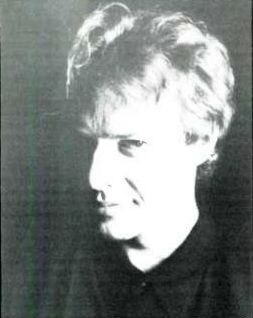
Danny Elfman
Eventually, this quirky theatrical ensemble moved their show indoors, playing places like the Aquarius and the Whisky, establishing week, even month-long residencies with a show that Elfman describes as "dark, surrealistic cabaret—with no contemporary music."
In 1979, after "seven full years of nonsense," Elfman and company dropped the Mystic Knights from the name, and drawing inspiration from the late Seventies English ska and pop movements (the Specials, Madness, Selecter and XTC), metamorphosed into a pop rock band, complete with a built-in horn section. Fueled by Elfman's nervous pop energy, the band recorded a four-song demo, which was slightly altered and released as their first EP on Miles Copeland's then fledgling label, I.R.S, and three albums for A & M—Only A Lad (1981), Nothing To Fear (1982) and Good For Your Soul (1983).
When asked about the A & M years and why the band changed producers in as many albums, Elfman cites his frustration over the recording process. "It wasn't the producer's fault," explains Elfman. "But when the albums got done, they never sounded like we were used to hearing ourselves onstage, and that's all we really ever wanted to get was a live, ambient sound. They always came out sounding very stilted and small."
With the band in label limbo, Elfman branched out on his own in 1984 and recorded So-Lo, a project he co-produced with Steve Bartek and engineer Paul Ratajczak that, ironically, featured most of the band. Released on MCA Records, soon to be Boingo's new home, the LP gave Elfman the opportunity to make peace with the studio and experiment, free from the influence of outside producers and the pressures of a band situation.
"Oingo Boingo songs had always been worked out and rehearsed before we ever went in the studio," states Elfman. "On the solo album, there were songs that weren't songs going into the studio. We took ideas into the studio, improvised parts on them and turned them into songs. Some of the songs, like 'Gratitude,' were really almost loose improvisations. It was the only time I've ever worked that way. But it was fun, because there was no pressure. I didn't have to worry about whether Oingo Boingo fans would think of it as horrible. And I didn't have the pressure of the band knowing that if it was a horrible album, they'd all starve that year."
It was also during this early Eighties period that the band came perilously close to calling it quits. "That was as close as ever. Not only were we between labels, but we didn't know where we were going and weren't earning a living at the time and we had guys in the band who weren't a hundred percent into it."
"On the last tour we had done," chimes in Boingo guitarist and co-producer Steve Bartek, "everybody was on edge. Some of the guys were complaining about other players in the band." "That's what breaks up bands," interjects Elfman, "unless you're the Rolling Stones and earn so much money that you don't give a fuck what the other guys in the band say about you, or how much you like 'em or hate 'em."
In 1985, revitalized by the addition of two new members, bassist/co-producer John Avila and keyboardist Mike Bacich, and the enthusiasm of a new record label, MCA, the band got its second wind and released Dead Man's Party. It included the catchy, offbeat title track (during which Elfman attends a macabre party with a rather unique entrance requirement: "leave your body and soul at the door") and the mini-hit "Weird Science" from the movie of the same name. Three albums have followed—Boi-ngo (1987), including two of Elfman's best compositions, "Home Again" and "We Close Our Eyes," Boingo Alive (1988), a live-in-the-studio two-record set marking the band's tenth anniversary, and the current Dark At The End Of The Tunnel—all featuring Elfman's penchant for spirited melodies and David Byrne-like lyrical neurosis.
 "I look at the last three albums that we've done, and I can feel a nice steady progression. I don't feel the frustration that I felt on our first three A & M albums, when we [were] searching for a progression but not really achieving it. I think, at the beginning, we were a little bit afraid to leave frenetic tempos and feels, and if we did try to leave it, we were uncomfortable. And now we've finally gotten to the point where nothing really scares us."
In addition to his seven-album stint as leader of Oingo Boingo, Elfman has made a lucrative career turn into the soundtrack arena. Interestingly, this mercurial pop songwriter has emerged as a highly sought-after film composer not with the usual rocked-up soundtracks currently in vogue, but with traditional orchestral scores.
"I was a hard-core film buff. I started at about eleven, twelve years old, and I pretty much spent every weekend of my life as a kid in a movie theatre. Then, as a teenager, I became more the cultivated film buff. I stopped calling it films and I started calling it cinema," he says, smiling at the pretension. "Throughout all of that, I was always a big fan of film music, and the film music that I loved was always based on a certain grand traditional scale. So that's what I turned to when I started doing my first composition for film."
Elfman received his big break when he was hired by director Tim Burton to score Pee-wee's Big Adventure. "Tim used to come and see Oingo Boingo all the time, and for some reason, he had a feeling—it was an intuitive feeling, I imagine—that I was capable of doing this type of work. So he called me in for a meeting, and we just kind of hit it off. I met Pee-wee Herman, and we talked for about an hour and a half. And I didn't think anything more about it—I certainly didn't think I was going to get the job."
For Elfman, who admits that "if I go down to my studio and decide I'm gonna write a song that day, I won't," composing for film presents a formidable challenge of concentration and composing endurance. "There's no waiting around for ideas when you're doing a film score. You're on a timetable, you have to write. Even if you feel sick, or uninspired, or the muse isn't with you that day, you still have to inspire yourself to do it, because you can't get behind. It's a discipline that I've never really known in my life. If you have 35 days to write a score that's seventy minutes long, and the orchestra's already booked before you even start writing the first note, and the film's release date is already set, you don't have a lot of leeway."
Elfman and Bartek (who helps Danny orchestrate the music) were definitely in the pressure cooker while working on another Tim Burton-directed feature, last year's box office giant, Batman. "There was a phenomenal amount of pressure riding on the film," explains Elfman. "And it was the kind of film where the music could really fuck it up or really help—which is why I'm attracted to the fantasy genre, because the music is by nature more important to the film."
For the first time in his soundtrack career, Elfman also had the pressure of having some very nervous movie executives looking over his shoulder awaiting the grand results. "It was the first time that I had to perform things for anybody other than the director. I had moments in my studio where I had film producer Jon Peters as well as Tim and two or three other people all sitting there saying, 'Well let's hear what you've got.' And I've never had to do that before. It was always just Tim and myself kind of fooling around. On Beetlejuice, I don't think anybody else even knew we were doing the music until it was done. And hearing Beetlejuice isn't enough to make someone relax and think, 'This guy can do Batman.' It was a project where I really had to convince people. And Jon Peters told me right at the beginning. He said, 'I'm really gonna put you through the ringer on this, because this score has to be really good. But at the end of the whole thing, you're gonna come out with some really good work.' And he gave me hell—he really did make me miserable. But the funny thing is, at the end of the project, he was right."
 Unfortunately, not only did Elfman have to contend with some very nervous Warner Bros. executives on Batman, but also with competing soundtrack scores. Initially, Warner Bros. put their promotional weight behind Prince's funk-filled pseudo-Batman soundtrack, instead of Elfman's more conventional film score, even though only a few minutes of Prince's music was used in the film. "It was only annoying before the movie came out," relates Elfman. "when a lot of people misinterpreted the hype and Prince was getting credit for doing the score and I was totally invisible. But I knew that once the movie came out, that everything would be fine. I always felt that the work would stand on its own."
Following his scoring of Nightbreed, the latest slice of the macabre to spring from the fertile imagination of horror master Clive Barker, Danny accepted another pressure filled assignment, the new Warren Beatty movie, Dick Tracy—a film that Beatty and the Disney studios have a lot riding on. Again, Elfman's traditional score will vie for attention alongside a more pop-oriented soundtrack release, this time an album of Dick Tracy songs by film co-star Madonna.
"Once again, there was a tremendous amount of pressure, and less than half the time," relates Elfman. "The big challenge with Tracy was the fact I came in really at the eleventh hour. They had somebody else, and there was a falling out. I was on another film, and what happened was it got moved back a month. I had finished Nightbreed, which was another grueling project, and I flew off on a three-day vacation. I landed, got to the hotel, and there was a message saying, 'Call home immediately, Warren Beatty wants to talk with you.' And I flew home and went from the airport to where Warren was doing voice-overs, and we met and that was that."
Since Elfman's star is on the ascent, and the rest of the band's fortunes rise and fall on the musical whims of their puckish leader, do any members of the band harbor resentment toward him? "They're insanely jealous," he quips. "I would call it seething, insane jealously [sic], bordering on absolute psychosis. I mean, my death has been plotted on the road so many times. I have to have food tasters with me. Quite simply, they want me dead. That's all there is to it. Not out of the band, that's not good enough. Not retired, we['re] talking dead, nonexistent. They want all the records of anything I've ever done destroyed. Newspaper articles, birth certificates, everything—they want it all gone, as if I never existed."
Sounds like there's a ring of truth mixed in with Elfman's martini-dry sense of humor. "It's all true," he continues, unwilling to drop the humorous pretense. "I have evidence that in my demise, there's already adoption proceedings for my children, that proposals have already been made to my wife and that they've already made arrangements to buy my house. It's like I will never have existed within three days."
Professional jealousies and comical digressions aside, Oingo Boingo has managed to sustain a worthy musical career while remaining uncompromisingly pure in artistic intent. "We never expected it to be easy," say[s] Elfman. "We never expected any red carpet."
And whether or not Dark At The End Of The Tunnel breaks any new commercial ground for the band, it probably won't matter to Elfman and company. One gets the feeling that Oingo Boingo will continue to exist in some parallel pop universe on the strength of a core of dedicated fans and the talented muse of their leader.
Source 1 - Source 2 - Source 3 - Source 4 - Source 5 - Source 6
.jpg)
.jpg)
.jpg)
.jpg)
.jpg)
.jpg)
Return