Danny
ELFMAN
P r o f i l e
by Julius Robinson
Fall 1988
Everything about Danny Elfman makes sense, even his name. An "elf' is variously defined as a small, often mischievous, yet graceful imaginary being in human form with magical powers. As a founding member of the '70s LA. theater group The Mystic Knights of the Oingo Boingo, which would later evolve into his brilliantly frenetic rock band Oingo Boingo, Elfman manages his career with a sorcerer's touch and an elfish industry, defying all the prescriptions for popular success.
Working almost non-stop over the last three years, he's mischievously gone against the traditional Hollywood grain for film composers and has become one of Hollywood's hottest film writers, scoring eight feature films, including "Midnight Run," “Beetle Juice," “Back To School," and both Pee Wee Herman films. He's currently working on "Scrooged" and is slated to score the feature "Batman." And all this without formal training in music or composition. "I'm like a one-armed batter in the big leagues," admits Elfman with a puckish grin.
To stay in
shape, Danny
works out
several times
a week with
his boxing
trainer,
George Gillio.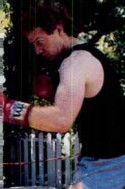
CHRIS HUNTER
Danny Elfman lives with his wife and two children in a rustic house clinging to the bottom of a steep embankment just above a running creek in the woody Santa Monica mountains outside of L.A. Lately, he spends most of his days and nights working on film scores in his home studio downstairs. There are 90 stone steps from the road down to the house, where the morning quiet is rudely disturbed by the sound of hammers and electric saws. In the small grassy yard above the creek there's a coy pond under construction, surrounded by a white picket fence. A man-made waterfall runs recirculated water and is babbling with more conviction than the real stony creek below. I'm greeted by a worker wearing a carpenter's belt, who tells me that Elfman's finishing up in the studio, and will be out momentarily. The worker's tone is more like a butler's than a hired hand.
A bespectacled Elfman appears, a youthful man of average size and pale skin (that blows the "elf" theory). We sit at a large table in a breakfast area adjoining the kitchen and just off the torn-up yard.
"This is a weird old house." explains Elfman. "I keep building, adding on — my truly unstoppable addiction in life is building. My wife is always complaining that I barely go through a month when there isn't a carpenter or an electrician or someone digging a hole or adding a wall. I'm constantly tweaking; it's like taking a rickety old melody and slowly turning it into a bizarre concerto."
Stranger
In A Strange
Land
Elfman leaped headfirst into film scoring when the call went out for an unknown composer for "Pee Wee's Big Adventure." He was, frankly, afraid.
"When I got the job, I almost passed on it," admits Elfman. "For the first time I had self-doubts -- I knew nothing about the technical requirements necessary to score a film. I told myself I'd just dive in. If I drowned I'd go back to shore wet and soggy with my tail between my legs and say 'Hey, I didn't know what I was doing, I'm only a rock & roller! I'm really sorry everybody, I wrecked the movie!' But during the four-and-a-half weeks doing the film, everything clicked. Having Oingo Boingo's guitarist Steve Bartek doing the arrangements and super music editor Bob Badamey helped enormously. Since then we've stuck together as a team.”
"I have no process of writing songs. It's exactly the opposite of my film scoring, which is extremely disciplined. You're working for the film. You can't say, Well this scene is a minute and a half long, but if only I could have written two and a half minutes this would have been a beautiful piece.' Doesn't work that way! The bottom line is you have to please the director and enhance the film."
Elfman has his own elaborate analogy for what it's like to score a film, a sort of "Stranger In A Strange Land" theory.
Danny with his daughters Mali, 4, and Lola, 9.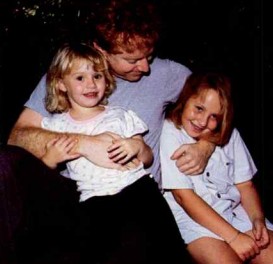
CHRIS HUNTER
"The film is a world unto itself, like a planet. Starting a film is like landing on a strange and unknown place in a rocket ship. 'Hi, I'm the composer. I'm here to score your film.' It's an incredible feeling. What's it going to be like? Is it going to be paradise or hell? Is it going to be a wonderful place where I can express myself artistically, or is [it] going to be like Saturn. with a methane-ammonia atmosphere, inhabited by headhunters and carnivores? Inevitably, within a week or two, you adapt, turn green, grow antennae, develop a third eye, and find yourself part of this new world, living and breathing their atmosphere. Four weeks later, ding there's my spaceship. 'Sorry I gotta fly back to earth.' Every film can be a wonderful experience, or the worst hell imaginable. You arrive with a ticket without any clue, but you always see it through to the end ... always!"
It's Elfman's perfectionism that led him and Oingo Boingo to recut live in the studio most of their favorite songs over the last 10 years. Titled Boingo Alive -- A Celebration Of A Decade, it will be a double album and CD, available this fall on MCA. The album will have 21 tracks, with an additional 40 minutes of material on the CD, including several new songs and previously unrecorded material.
"The new album is something we've been wanting to do for six or seven years," explains Elfman. "We never really felt in our early albums that we captured the spirit and energy of our stage performances. That's what our fans have been telling us. It's not because we didn't want to-- we just didn't know how to then."
"I write what I write.
Some people get it,
some don't."
"On Boingo Alive we went for spirit instead of accuracy. To do 30 songs, recorded and mixed in two weeks, was quite an accomplishment for us. We moved into a large rehearsal soundstage and set up in a circle, no one used headphones, just monitors. We had a few problems, like getting the drums out of the vocal mikes."
Elfman feels that the album captures the raw essence of the live shown without the technical limitations of being on a concert stage such as feedback and the roar of the crowd.
Danny with his pal "Mr. Skeleton," his prized possession
from Bamako, Mali and a small part of his
African and Indonesian instrument collection.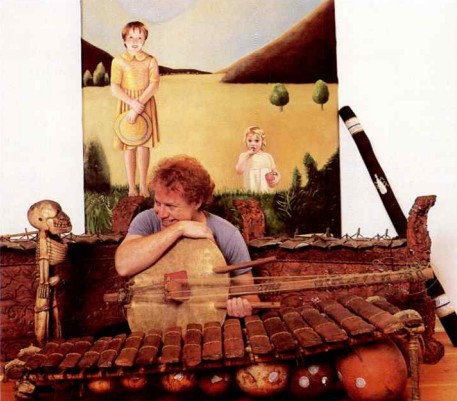
CHRIS HUNTER
"When you listen to most live albums, they're a memento of a concert," says Elfman. "I wanted this to be a memento of our last decade together."
Breaking the rules is part of Oingo Boingo's tradition. Even their name upsets a lot of people. Notes Elfman: "It's like that Johnny Cash son[g], 'A Boy Named Sue.' Having our name got such a horrible reaction, it toughened us up. 'Yeah, we're Oingo Boingo, if you don't like it, cross this line!'"
"When we started out, if you could pick all the qualities that would make it the absolute hardest to succeed in this industry, that would be like the Oingo Boingo in '79," says Elfman. "The size of the band (8-10), the amount of equipment we had, the music was pop, ska, very arrogant. We decided never to deal with loves themes or boy meets girl. That was the law. Rock and pop are 90 percent alienation of boy meets girl, or some variation thereof."
"Every film can be
a wonderful experience,
or the worst hell
imaginable."
With only a couple of hits, "Weird Science" (written for the John Hughes film), and "Dead Man's Party," Oingo Boingo and Elfman have managed to establish a huge following that sells out venues with a hyperactive display of musical virtuosity that's both exhilarating and exhausting to watch. Nonetheless, Elfman feels stifled by radio, which he feels has the group pigeon-holed.
"This is an industry that marks you as you come off the assembly line, you're given a stamp which you carry forever. With us it was the mark of Cain. What we do now has very little to do with the kind of irritating, pissed-off, quirky stuff that we did when we started out, stuff intentionally designed to aggravate. I could write the most soothing, calm song and they'd still call us quirky."
"I write what I write. Some people get it, some don't. I'm honored and amazed that we get such fanatic support from young people out there, they treat us like a home town team."
The retrospective nature of the new record gets Elfman talking about the motivating forces in his youth. He has a morbid sense of humor. Was it any accident that the first two songs on the live record have the word "dead" in the title?
Oingo Boingo (l-r): Dale Turner, Leon Schneiderman, Sam Phipps,
Danny Elfman, Steve Bartek,
John Hernandez, Carl Graves, John Avila.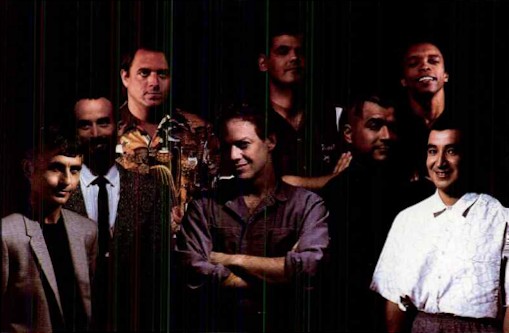
JOHN SCARPATI/MCA RECORDS
"It was intentional that I put 'Dead Man's Party' and 'Dead or Alive' first on the live record because I thought it'd be fun to have my two 'dead people songs,' written eight years apart, back to back. I've always loved black comedy; that's why I have a good feel for films like 'Beetle Juice.'"
"When I was a kid I was obsessed by [sic] horror and fantasy," Elfman recalls. "The walls of my room were lined with photographs clipped from Famous Monsters of Filmland magazines. I've always had a special place in my heart with the genre. I talked about it in my song 'No One Lives Forever,' my obsession with laughing at death, skirting around while the grim reaper lashes out with his sickle, while we're trying to leap over it, dodging as we go."
Wearing two hats as a band leader and film composer is tough, but Elfman feels he's got the energy to maintain both: "I want to keep the two careers going for as long as possible, it's very difficult, I've not had any time off in two years. If I have a nervous breakdown, it'll be when I slow down."
Concludes Elfman, "A band has a limited life-span, being in one is like being a ballet dancer or a boxer. It's one of the shortest careers on earth. I have no doubt what I'll be doing when I'm 60: I'll be writing for films. I know I won't be on a concert stage jumping around. There's only so many years I can keep both sides alive."
Julius Robinson is west coast editor of Cash Box magazine.
Source 1 - Source 2 - Source 3
.jpg)
.jpg)
.jpg)
Return