BOINGO SHORTENS ITS NAME,
BUT EXTENDS LEGACY WITH GIANT SET
by Gil Griffin
09/04/1994
NEW YORK—With a new name, a fresh new sound, and a new label, Oingo Boingo—the eccentric Los Angeles group with a regional cult following—has been reborn after a four-year recording hiatus. Now known as Boingo—which most of its fans had already called it—the group continues its musical experimentation, but its quirky, mid–'80s "Weird Science" days are history. No longer a synth/dance/pop band, Boingo rocks on its self-titled Giant Records album—literally. With music ripe for modern and album rock programmers' picking, the Giant staff will take the music to both radio formats. Giant hopes to make Boingo—which has been around for 15 years and recorded seven previous albums—a truly national act.
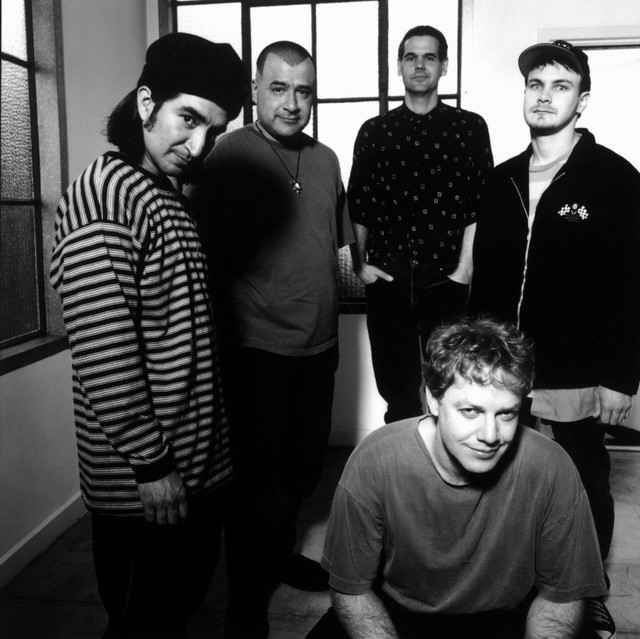
BOINGO: John Avila, Johnny "Vatos" Hernandez, Steve
Bartek, Warren Fitzgerald, and, kneeling, Danny Elfman.
"Their weakest market has been east of the Rockies," says Steve Backer, Giant's head of marketing. "We're calling our marketing plan for Boingo the 'East of the Rockies' plan. We're going to attack these markets aggressively."
Boingo is headed by the extraordinarily creative Danny Elfman—the same Danny Elfman who has composed scores for such well–known films as "Edward Scissorhands," "Beetlejuice," and "Batman," as well as the theme for the Fox television series "The Simpsons." Backer says Elfman's fame will help Boingo's records sell.
"Retailers and programmers know who Danny Elfman is," Backer says, "and lots of opportunities exist because of Danny's connection to movies." Backer says Giant may show Boingo videos at movie theaters. "We're also going to have MTV involved," he adds. "They haven't been a part of Boingo before, but we're going to make a video (for the song 'Hey!') that's going to be a jaw-dropper. Not to have a video would be criminal."
It also would be criminal if the band's name change caused any confusion among record buyers trying to find Boingo product at retail outlets. (That's why MCA—the band's old label—wouldn't allow it to change its name, Elfman says.)
Backer says a special Boingo record launch in L.A. is being planned, and that a national Boingo tour is imminent. "One of Boingo's strongest suits is the live show," Backer says. "They've toured before, but there wasn't much radio interest in it and there wasn't a whole lot of demand."
But Elfman hopes any tour by the band won't go on too long. "I can't see playing on tour every night for six to nine months," says Elfman.
He concedes that using orchestral accompaniments on new Boingo songs such as "Insanity" and "Mary" was influenced by his film scoring, and says that inspiration for his new writing came from sounds he heard coming from his 15-year-old daughter's bedroom.
"I heard her listening to her Beatles records, and then I started exchanging albums with her," Elfman says. "Then I started listening to the Beatles, Jimi Hendrix, and Led Zeppelin. The Beatles had a wild abandon for changing style from tune to tune. I've always wanted our albums to be eclectic, and I've been pining for the day when we could just let our minds wander."
Elfman and company wander to their hearts' content on the new album, which stretches over 70 minutes. One song, "Change," is 16 minutes long, while another, "Pedestrian Wolves," is just over nine minutes. While Boingo's cover of "I Am The Walrus" pays homage to the Fab Four, the dramatic, choral singing in "War Again" and "Lost Like This" recalls vintage Queen. The group closes its 12-song album with an uproarious, previously unreleased tune from the days when the band was known as the Mystic Knights. Called "Helpless," the song features incongruous accordion riffs, drum march rhythms, and Elfman's adopted hoarse roaring in the chorus.
"It was a challenge leaving dance music behind and not using sequencers," Elfman says. "It's the most challenging, fun and difficult record we've ever done. It felt like a cold bucket of water splashed in our faces."
But Elfman knows that Boingo's longtime fans may take the band's change in sound as a slap in the face. "I'm expecting to get a lot of nasty letters," Elfman says. "I got them when I recorded 'Dead Man's Party' in 1985. Fans would write and say they made Oingo Boingo, and in separating and changing we abandoned them."
"With any band that's been around as long as Boingo, the music constantly changes and evolves," Backer says. "Sometimes hardcore fans will be sacrificed. But they're making the album they've always wanted to make, and [marketing it] is a major priority for us."
.jpg)
.jpg)
Return