OINGO BOINGO
ART AND STORY BY DANNY ELFMAN
by Danny Elfman
1982
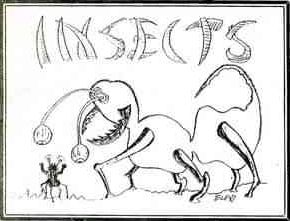
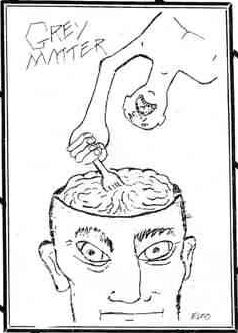
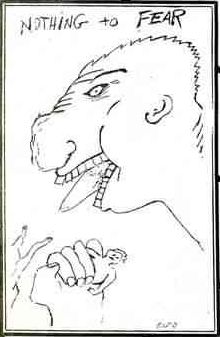
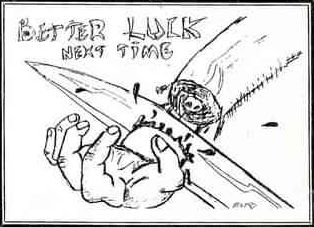
TiTleS FroM OiNgO BoiNgO's
AlBuM "NotHinG to FeaR."
The Complete and Final Historical Biography
by Danny Elfman
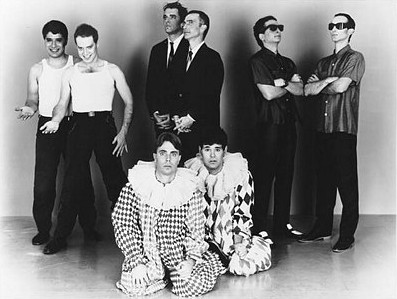
OINGO BOINGO. (from right to left) Johnny "VATOS" Hernandez, Danny Elfman, Sam
"Sluggo" Phipps, Dale Turner, Richard Gibbs, Leon Schneiderman,
(front row) Kerry Hatch, Steve Bartek
PHASE I (1971 — 1973). Oingo Boingo was formed 10 years ago by Rick Elfman, while his older [sic] brother, Danny, was tramping through the remote regions of Western and Central Africa. Originally an avante-garde, street-theater group (or "troupe") their shows revolved around unique rhythms and bits of circus-like theatrics. After returning home, Danny became the band's musical director, as well as the fire-breathing, trombone/violin/guitar-playing singer. All of these talents came without the aid of any musical background or training.
PHASE II (1973 — 1975). Now a 12-piece musical-theatric group, Oingo Boingo is the most visibly recognized for their bizarre stage antics and frenzied rhythms. By taking over small theaters, and transforming them into musical mad-houses, a loyal following is built. During this period all the instruments utilized are acoustic. No rock. A shame and complete disgust for '70's music.
PHASE III (1975 — 1978). After Rick left to make movies, Oingo Boingo becomes a 9-piece, multi-media band. The performances become much more musically-oriented, while the productions become expensive and intricate, not to mention grueling. A typical show runs 2½ hours, with 6 filmed segments, two animated ones, 6—7 set changes, 6—8 costume changes and some 20 musical numbers. Quite successful. A little rock!
PHASE IV (1978 — 1980). Oingo Boingo becomes an 8-piece group, as original music begins to take precedence. Costumes and theatrics are scrapped so the band can begin to focus on the delivery of the music. The change costs Oingo Boingo about 90% of their audience, who brand them as traitors. The acoustic syndrome is re-introduced. No commercial interest.
PHASE V (1980 — 1982). Today, Oingo Boingo is still an 8-piece unit that has built a strong (almost fanatical) following with younger audiences. A debut 4-song EP on IRS does well, the first album for A & M (Only A Lad) does better. During the first half of 1982, the band creates music for three films.
The self-produced second album for A & M (Nothing to Fear) promises to surprise even the most hard-core Oingo Boingo fan, with its unusual, energetic collection of songs that reflect various mood and texture changes. Nothing to Fear is driven by Oingo Boingo's usage of West African and hand-built percussion, and the horn section. Standout tracks include "Grey Matter," "Insects," and "Wild Sex" (all are schizophrenic dance numbers). More accessible selections include "Private Life," "(Let's Take) The Whole Day Off" and "Why'd We Come This Way." Don't miss the lyrics to the eerie title song.
STEVE BARTEK — Lead guitar, arrangements and vocals
DANNY ELFMAN — Lead vocals, rhythm guitar
RICH GIBBS — Synthesizer
JOHNNY "VATOS" HERNANDEZ — Drums
SAM PHIPPS — Tenor and soprano saxophone
DALE TURNER — Trumpet, valve trombone
LEON SCHNEIDERMAN — Alto-bari saxophone
KERRY HATCH — Bass, vocals
.jpg)
.jpg)
Return